
Sympathy for the Devil (featured in Football Weekends magazine)
- Robert Moyse
- May 3, 2025
- 6 min read


"Wir fahren nach Berlin!" ...is the chant sung by many German football club fanbases during their plucky DFB Pokal runs, however today it also applies to me, a life-long Hull City fan. I'm going to Berlin for a long weekend and will take in 2 very different football matches whilst I'm at it.
Whilst many outsiders will laud German football culture for the cheap beer, Kuttes (those scruffy denim jackets with football badges sewn onto them), and drunken fans setting off pyros every 5 seconds, I'm drawn to the community centric mentalities that are fundamental to all German football clubs. Whether it be the fiery anarchist spirit of St Pauli or the hippy-ish SC Freiburg fans cycling to home matches together through the city in convoy.
This is not more apparent than in the vibrant, diverse, and gritty city of Berlin. The city has been invaded, sieged, and controlled by most European powers throughout history, which the city still lives in the shadows of, displaying its scars as a mark of resilience. Because of this, Berlin is one of the few cities where your chosen football club can say a lot about your identity and beliefs. Are you from the east (Union) or west (Hertha)? Are you Turkish (Türkiyemspor)? Jewish (Makkabi Berlin)? Do you align politically with the left (Tennis Borussia Berlin) or with the right (BFC Dynamo). And that brings me to this trip. 2 games, 2 days, 2 very different clubs.
(Game 1) Friday - Tasmania Berlin Vs Tennis Borussia Berlin

I first heard about Tasmania Berlin through a mini-documentary on YouTube about Tasmania's only claim to fame (which they carry as a badge of honour!): the record for the worst season in Bundesliga history in 1965/66. The story of how this season came to be is perhaps even weirder than the record itself.
In the summer of 1965, Hertha Berlin was kicked out of the Bundesliga for breaching the German FFP rules. This meant that there was no team from West Berlin in the Bundesliga. As this was in the early days of the wall, there was significant political pressure to have West Berlin representation in the top German football league. So the DFB looked to the Berlin Regionaliga (the 2nd tier of Germany at the time) …
1st placed Tennis Borussia Berlin ("TeeBee") unfortunately lost out in the promotion playoffs to Bayern Munich and 2nd placed Spandau SV Berlin flat out declined the offer to go up to the Bundesliga (maybe they knew what awaited them!). This brings us to 3rd placed Tasmania Berlin, who were very happy to take up the offer on the fantastically optimistic basis of a 'screw it, we may as well, if we lose we lose' mentality. This offer was accepted only a couple weeks before the new season kicked off and many Tasmania players had to be called back from their summer holidays via what I can only imagine were some spectacular radio messages:
*...if any of our listeners play for Tasmania, get your arse back to the motherland immediately, you're in the big time now!! *
Their first match of that season was a roaring 2-0 home win against Karlsruhe at the Olympiastadion. What happened next remains in German football folklore. In short, here are SOME of the Bundesliga records that Tasmania still hold today:
Fewest points in a season: 8 (10 points under today's system).
Fewest wins in a season: 2 (tied by Wuppertaler SV)
Only Bundesliga team without an away win.
Longest winless streak: 31 games (14 August 1965 – 21 May 1966)
My eagerness has led me to arriving at Tasmania’s home, the Werner-Seelenbinder-Sportpark in Neukölln an hour early. I’m sat pitchside on a bar stool drinking a pre game Staropramen as players from both squads walk right by me. Tasmania's red, white and blue seats cover the central third of both sides of the stands (only going 5 rows back) with the rest all standing terraces. A very simple affair, home fans on the left, away on the right. A surprisingly decent €3 hotdog and €3 beer later, it’s time for the game.
TeeBee came out of the blocks quicker and with more intent. Their chances looked more like they'd end up in the back of the net. They finally got their break in the 34th minute with a close ranged header. Whenever Tasmania went forward in the first half, it was as if their players weren't prepared for such an opportunity. The TeeBee fans seemed more up for it as well, serenading us all with a number of football chants… in English??
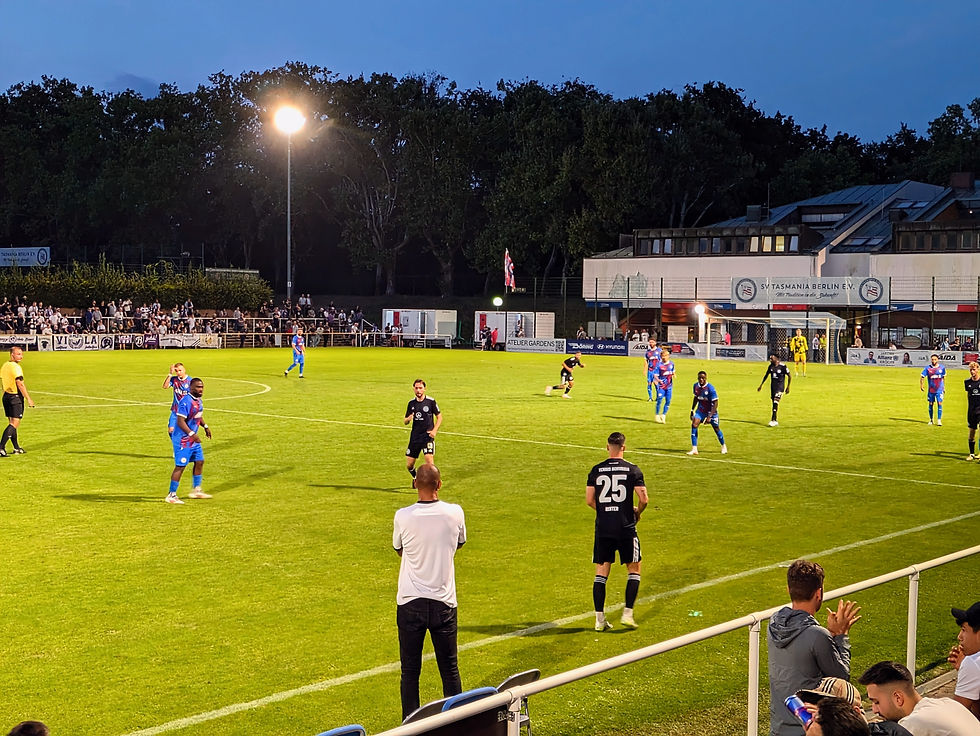
Halftime came extremely controversially for TeeBee. Their midfield played a perfect looping ball into their attacking half to a player who broke the offside trap and and just as the ball reached the attackers feet, the halftime whistle blew. Cue pandemonium from every one of the TeeBee players, and subsequently, a couple of yellow cards for dissent. During half time I got chatting to an American guy who sat behind me, and found out he's Tasmania’s new signing waiting for his work visa to come through!
In the 2nd half, Tasmania fought back, passing more directly which led them to being 2-1 up at 55mins. The lead would last until the 71st minute, with a confident strike from TeeBee. Unfortunately, TeeBee did it again in the 85th, cue the roar from the small but mighty away fan contingent. A frustrating end to the game for Tasmania who missed some solid chances in the second half. However, TeeBee was the stronger team overall and deservedly went home as the victors.
(Game 2) Saturday - Hertha Berlin Vs Jahn Regensburg
In Berlin, nobody believes that their team is 'the team' of Berlin. They respect that each team represents different histories, struggles, and segments of society. That being said; if you were to decide who the biggest team in Berlin was based on the number of stickers on lamposts and street-signs across the city (east and west), Hertha would be the runaway winner.
Taking the S-Bahn west out to leafy Charlottenburg, you see growing numbers of blue and white Hertha shirts and scarfs In Germany, everybody wears their team's colours.

I walk out of the already crowded Olympiastadion station, where in typical German style, the fans are already drinking bottles of Berliner-Kindl, walking under the famous archway. Football here is a truly social affair. Once you get closer to the stadium there are dozens of food and drink stands selling the almost comically German food: Currywurst, Hotdogs (Translation: footlong sausage in a small crusty bread roll), and the classic Berliner Boulette (a chunky pork burger with curry powder and ketchup) which is what I went for. All of these were sold at a very affordable €4 each. It's 28°C at 11am, something the northern Germans (and this northern Brit) are not acclimatised to. A pre-game pint only helped slightly.

I grew up going to lowkey no nonsense Championship and League One grounds so the novelty of going to a Champions League caliber stadium is not lost on me. And as an urban planner with a visceral distaste for brutalist architecture, the grand and imposing Olympiastadion, bathed in this slightly too sweaty summer sun, is one of most picture-perfect footballing sights I've ever witnessed.
The Hertha ultras section takes up the whole ‘Ostkurve’ (eastern corner) section of approx 10,000+ people, all of whom are bouncing and waving flags way before kickoff. Jahn Regensburg packed out their modest section opposite me and are making a good go at out-chanting Hertha. Despite not being a native, I was still able to join in the signature HaHoHe chants and ‘Nur Nach Hause’ anthem before kickoff. This buzzing atmosphere continued throughout the game, with the emboldened Ostkurve conducting proceedings. German fans unashamedly and unabashedly support their clubs, something us Brits are too awkward and self conscious to do. We should work on that…
As for the game, neither team seemed like they wanted to score in the first half, despite Hertha having more possession and having the ball in opposition half frequently. A bit hairy at times for Hertha. It wasn’t until the last 15 minutes where the goalkeepers got to earn their salary. In the 89th minute, Hertha finally break through with a cross from the edge of the 6-yard box bouncing between the keepers legs and in. Hertha quickly nab a second courtesy of a powerful Neiderlechner strike that trickled over the line off the keeper at 90+6.
The full-time whistle blew seconds afterwards and despite the performance being far from empowering, the Hertha fans will not care and will hope to soon see ‘The Alte Dame’ (The Old Lady) back in the big time this time next year.
German football fan culture encapsulates the greatest, purist, and most necessary elements of football. I can’t wait to go back again. I hope that the pictures do it some justice.


Comments